
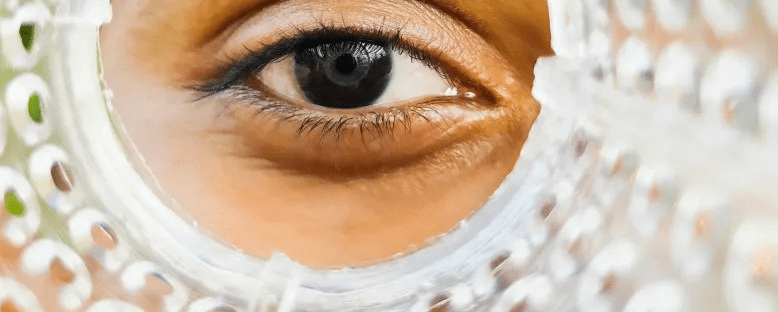
In a late lecture course, Merleau-Ponty proposes a novel and original framework for investigating the evolution of homo sapiens. Prior to becoming the rational or linguistic animal, human being is “another way of being a body.” Of course, the study of the evolution of human anatomy – bipedalism, the fully opposable thumb, increased cranial capacity – had long been established already in Merleau-Ponty’s time. His distinctive contribution, however, is his emphasis on the appearance of the human body as a social body that both senses and is sensed by others. He calls for an “esthesiology,” a study of how the human body has evolved as an “organ of the for-other.” It is a body for being perceived and being acted-upon and -with, as much as a body for perceiving and acting. I apply this esthesiological framework to interpret the evolution of the distinctive morphology and expressivity of the human eye.
In this paper I primarily offer an exegesis and reconstruction of Merleau-Ponty’s esthesiology and a discussion of the historical sources (especially Portmann and Husserl) that shaped his view. This work will prepare the way for more systematic applications of the esthesiological framework in future publications. The esthesiological approach will allow us to appreciate the bodily, sensory, and social aspects of human evolution and their foundational role in the cultural and linguistic form of life characteristic of human beings.
Read this paper online at the publisher’s site, or at my academia.edu page.
Click here to return to the main research page.
Kee, Hayden. 2023. “Evolution and Esthesiology: Seeing the Eye through Merleau-Ponty’s Nature and Logos Lectures.” HUMANA.MENTE Journal of Philosophical Studies 16 (43): 297–322.

 Hayden Kee